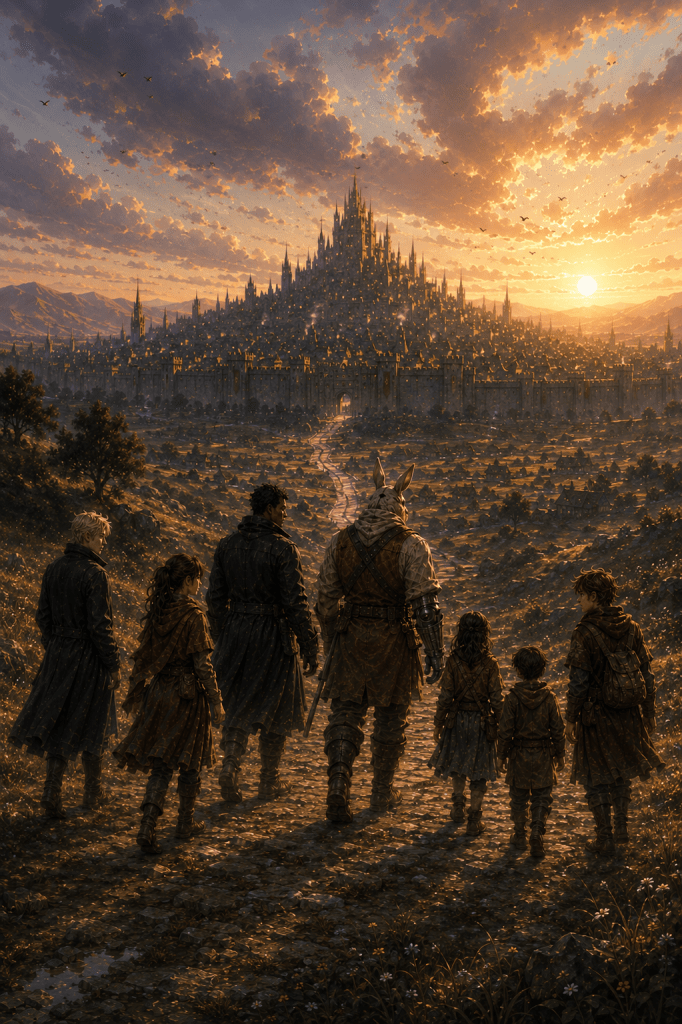
Jet, Noel, Homer, Ben, and Ember went down to the nearest town to collect their client. Liz and Becca had stayed behind to mind the cabin. The Owls waited in the town square. The longer they waited, the less Jet looked like a man who believed in the job.
“You’re sure they’re coming.”
“They’ll come.” Homer stood easy. “Lost track of the hour, most likely.”
“Right.” Jet did not sound convinced. “What do they look like, at least? How old?”
Before Homer could answer, two children came across the square toward them. A girl, ten or so. A boy a few years younger. Both wore clothes that had been somebody else’s first, and somebody else’s before that. The girl went straight to Homer.
“We’re ready!”
Jet shut his eyes and pinched the bridge of his nose. A long breath went out of him.
“Homer.” Quiet. “You swore you wouldn’t do this again.”
Homer considered it. “I don’t believe I ever swore that, no.”
“Excuse us a moment.” Jet caught Homer by the elbow and steered him off across the square. Ben and Ember trailed after. Noel didn’t move. He watched the others go, then looked down at the two children looking up at him, and after a moment he turned and walked toward the nearest tavern.
Out of earshot, Jet rounded on him.
“You can’t keep doing this.”
“We’re going to the capital anyway.” Homer kept his voice down to match. “What’s the harm in them coming with us?”
“The harm is they don’t pay. We could’ve taken merchants. Someone with coin. We’re not made of money, Homer, you know that.” Jet looked back at the kids and lowered his voice further. “The second you found them you stopped looking for a real client. Didn’t you?”
Homer let that sit a beat. “They’re frightened, Jet. I think they were trafficked here and got free. They need to get home.”
“Every third child you meet has that story. We can’t save all of them.”
“We can save these two.”
“It isn’t our problem.”
“It is exactly our problem.” Homer didn’t raise his voice, but something underneath it set. “Because we’re the ones who can. If we walk past them, we’re no better than the men who took them.” He held Jet’s eye. “We were those children once. What’s the difference between them and us? Tell me.”
Jet pinched the bridge of his nose again. He turned and found Ember and Ben watching him, and neither of them was on his side, and they weren’t trying to hide it.
“You’re really set on making me the villain here.”
“No.” Homer almost smiled. “I’m reminding you you’re not.”
Jet knew when he’d lost. He shook his head.
“Fine.” He walked back to the children with the rest of them behind him. “All right. Let’s get you home.” He scanned the square. “Where’s the other one? The miserable-looking one.”
A small finger pointed at the tavern.
Jet groaned and went after him. Less than a minute later, the two of them came back out, Noel already a good deal further into the day’s drinking. Jet slapped himself once on each cheek, hard, as if to wake up to the fact of what he’d agreed to.
“Right.” He put a smile on over the top of it. “Who’s ready for an adventure?”
They set out for the capital, Jet up front with Ember, Homer and Ben in the middle with the two children, Noel trailing a few yards back from everyone.
“So,” Ember said. “Is there anything I can do? To earn my place?”
“Sure.”
“Like — like what?”
“Well.” Jet thought about it. “You ever been in a fight?”
“No.” It came out small.
“That’s all right, I can teach you. Any herblore?”
“No.”
“Smithing?”
“No.”
“Any healing? Medicine?”
“No.”
“Anything you can think of. Anything that’d be useful.”
Ember turned it over. “I can wait tables. And tend a bar.”
Jet laughed. “Maybe we should open a tavern.”
They walked a while without talking.
“What’s everyone else good for?” she asked. “If you don’t mind.”
“I’m the leader. Noel fights. Homer fights, and he’s our smith. Becca’s the best bow among us — she’ll put an arrow somewhere you didn’t know was a place. Liz reads a battle better than anyone I’ve met, and she can hold her own besides. Ben’s everyone’s right hand. Jack of all the trades that need doing.”
Ember glanced back at Homer with a child on either side of him. “I didn’t take Homer for a fighter. He’s big, but I’ve never seen him carry weapons.”
Jet’s mouth went sideways. “Homer’s always armed.”
He looked pleased with himself, like he’d said something clever and was waiting to be caught at it. Ember frowned, not following.
Noel cleared his throat behind them.
“Homer has great command of his Will.” Noel’s voice came flat and low. “How much do you know of Will?”
“Will…” Ember turned the word over. She looked at him. “You mean — the Almighty Will?”
Jet’s eyebrow went up. “Now there’s a phrase I haven’t heard in years. Where’d a tavern girl pick that up?”
“A customer. A long time ago.” She tilted her head, reaching for it. “I don’t know much. Only the name.”
“It’s old. People don’t say it much around here.” He walked as he talked, eyes on the road. “The story goes that a timeless thing made the world. Its will was strong enough to forge what’s real out of nothing. People have believed some version of that for thousands of years. So when men and women started doing things that shouldn’t have been possible, the old believers didn’t call it magic. They called it Will — said it was the same force, only smaller. A spark of the thing that made everything, sitting in a person.”
A wagon came rattling toward them, forcing the group to the edge of the road. Jet waited until it passed before going on.
“So what is it?” Ember asked.
“It’s the thing every soul has.” Jet said it plainly, the way you’d name a tool. “It’s what lets you be who you are. Choose. Act. Be a person instead of a thing.” He stepped over a rut without looking. “Some people learn to push it into their own body. Drive themselves faster, stronger, past what the body should allow. Noel and I are good at that one.”
Her eyes widened. “That’s how Noel got me back to camp. He moved so fast the trees started to blur.”
“That’s it. It’s hard to learn and easy to ruin yourself with. You’re not just deciding to be stronger — you’re laying your Will into the muscle and the bone, fiber by fiber, and asking it to hold past where it wants to tear. Get the line wrong and you break what you were trying to use.”
Ember flexed her fingers as though she might feel something moving through them. Noel watched her do it.
“Don’t try it,” he said.
Jet glanced back at him. “And that’s the easy half. The hard half is pushing your Will out — onto the world instead of yourself. Bending the thing around you rather than the thing inside you. Takes a particular kind of mind. That’s how Homer fights. Liz too. Becca, after a fashion.”
Ember walked with that for a moment. Then she looked at him sidelong.
“You said people around here don’t talk about the Almighty Will. So why do you know it?”
A small smile, surprised she’d circled back to it. “My family kept to the old religion. I heard it all the time, growing up.”
“Do you still believe it?” She caught herself. “Did you ever?”
Jet looked off down the road and let several paces go by before he answered.
“Once. A long way back.” He kept his eyes on the distance. “Believing in the Almighty Will means believing in things like fate. Destiny. Things I’m not sure I’d like to be true.”
“What’s the difference? Fate and destiny.”
“Fate says the road’s already laid. Whatever you want, whatever you do, you’ll end where you were always going to end, and you never had a hand in it.” He turned the other one over slower. “Destiny says you’ve been handed an end to reach — but whether you reach it is yours to win or lose. Most people I’ve met live by one or the other. The road that’s fixed, or the road that’s theirs to walk.”
“Or luck,” Ember said.
It came out of her before she’d meant it to. A grizzled man at her counter, the last morning before all of this, turning a coin over in his fingers and talking about luck like it was a kindness someone did you.
Jet laughed, caught off guard. “Or luck. True enough. Maybe none of it’s planned and the whole thing’s just the dice falling. The trick is telling which of the three you’re living in. Fate, destiny, or chance.”
“Or how they’re alike,” Ember said. “Not how they’re different.”
Jet looked at her.
“Maybe fate and destiny and luck aren’t three things. Maybe we only call them different things because we can’t see all of it at once.” She slowed on it. “Maybe they’re three ways of squinting at the same Almighty Will.” Then she shrugged, suddenly aware of herself. “I don’t know. What would I know about it.”
Jet had stopped looking at the road. He was looking at her.
“No,” he said. “I like that.” He tipped his head, something turning behind his eyes. “Stop fretting about what work you can do for us. We’ll find your place. I’ve no doubt about it now.”
Ember smiled. Then it slipped. “Why did you grin? When you said Homer’s always armed.”
Jet squinted at the road ahead, where a knot of soldiers stood across it half a mile on.
“You may be about to find out.”
“State your business.”
“Mercenaries.” Jet’s voice stayed level and pleasant. “Escorting these two back to their family in the capital.”
The soldier looked the children over, the borrowed clothes, the dirt. “They don’t look like they’ve got family in the capital.”
“Got rained on. That’s the best we had to put them in.” Jet didn’t blink. “Father’s a merchant. Mother bakes, I think.”
“What’s the father sell?”
Jet shrugged. “Couldn’t tell you. Didn’t ask.”
The soldier grunted. Then: “There’s a toll on this road.”
“Came through here last week. Wasn’t one then.”
Irritation flickered across the soldier’s face. Ember had the sense he had heard that same objection more than once since morning.
“Road’s been bought. One of the Big Spenders. There’s a toll now and we’re here to see it’s paid.” He took in the lot of them, the children, and his shoulders went down a notch. “Just give what you can.”
Jet dug out a single silver and held it up. The soldier looked at it and weighed asking for more, and decided against it.
“Go on, then.”
They went on. The children had gone quiet and wide-eyed at the checkpoint, so Homer started in on a story to ease them, and his voice rolled along behind the group the rest of the way. Noel trailed where he always trailed.
“Do you think I could learn it?” Ember asked. “Will.”
“Maybe. It’s not impossible.” Jet didn’t sugarcoat it. “But it might be a year you don’t have, for a thing you might never be good at. Better we find the work you’re already shaped for. You think of it, you tell me.”
“All right,” she said, and didn’t mean it.
The road took two days. They slept beneath the trees the first night, the children tucked between Homer and Ben beneath the warmest blankets. Ember woke twice and found someone different keeping watch, though she had never heard them decide whose turn it was.
At the end of the second day the city rose up ahead, and they came to the gates. The younger child squeezed his sister’s hand so tightly she winced, but she didn’t let go.
It was the people that took Ember first — more of them in one place than she had names for, a town’s worth pressed into a single street and then more streets behind it.
Then it was the state of it. She’d pictured the capital gleaming. The edge of it was not gleaming. It was grey and close and ground-down, the people in it thin and patched, and only as they pushed inward did the streets start to clean themselves up, the stones evening out, the coats getting better cut, the faces getting fed.
“The outskirts are the poorest part,” Jet said. “There’s a stretch on the south edge that’s worse than the rest. People call it the slums. That’s likely where these two are from. It’s where most of the taken children go missing from in the first place.”
He turned and looked the group over, scratched his head, thinking.
“Homer — take Ben and Noel, get the kids home. Ember and I’ll go see the boss about work.”
Homer nodded. The girl looked from him to Ember.
“You’re not coming?”
“Not yet.” Ember smiled. “But you’re nearly home.”
The girl considered that, then gave her a small wave. Ember returned it. Homer gave her a thumbs-up over the children’s heads and led his half toward the south.
Ember caught Jet up. “Why am I coming to meet the boss?”
“Because we’ve too many fighters and only one diplomat. Me. I’m the only one of us who sits across a table from the people with the coin and talks them into parting with it.” He glanced at her. “You learn to do that, we double our work without adding a single sword. And don’t make that face — it’s the most important job we’ve got. Waiting tables, tending bar, reading a room, keeping a hard man sweet while you tell him no — that’s the whole of it. Watch what I do. Keep it.”
“Oh.”
They walked deeper in. More soldiers now, more fine clothes, and here and there someone in clothes finer than all of it — men and women with worked insignia stitched at the breast, hemmed in on every side by guards in heavy plate.
“Who are they?”
“Merchants. A guild of them, thirteen all told. They call themselves the Golden Hand. Everyone else calls them Big Spenders.” Jet watched one pass. “Between them they’re worth more than the crown, near enough. Each one’s got his own mark and carries on like he was born to a throne. And being that rich, some of them keep the best mercenary companies on a leash, to guard their persons and their trade.”
“We don’t work for one of them?” She’d assumed it. “The way you and Noel fight, I thought we’d be a top company.”
“We are a top company.” Jet said it without heat. “We just don’t work for a Big Spender.”
He let it lie there, and didn’t open it, so she let it go.
“Okay.”
It was the better part of two hours more before they came to it — a high worked gate, and behind the gate a castle that put everything else in the city in its shadow. Ember stared. She had not understood they were walking this far up.
“I don’t understand,” she tried again. “Who is the boss?”
Jet smiled and put a finger to his lips.
He raised a hand to the guard on the gate, who lit up at the sight of him.
“You got the goods?” the guard murmured.
Jet reached into his bag and came out with what looked, plainly, like candy. “Here, Allen. Tell the kids I said hello.”
Allen pocketed it, grinning. “Here to see the princess?”
“That’s right.”
“Come on through, then. I’ll walk you up myself.”
 The Silent Beggar's Anthology